


Space Risk Management: How Space Missions Identify, Assess and Mitigate Risk
Author: Iván Sermanoukian
Space risk management is a critical discipline in the aerospace sector because every mission operates under uncertainty. In space projects, even a single unplanned event can affect budget, schedule, technical performance, safety, or mission success. For that reason, risk management is not a secondary task added at the end of a project. It is a continuous process that supports decision-making from the earliest concept phase to launch, operations, and end-of-life planning.
To understand space risk management, it is first essential to understand what risk means. A risk is an uncertain event or condition that can influence the success of project objectives. This influence can be negative, such as a threat that causes delays or technical failures, or positive, such as an opportunity that improves performance, reduces cost, or creates strategic advantage. In practice, strong risk management means preparing for both. It means reducing threats while also recognizing opportunities that could strengthen the mission.
In the space industry, this is especially important because projects are technically complex, expensive, and often irreversible once critical stages begin. Spacecraft design, manufacturing, transportation, launch, and operations all involve uncertainties. A failure before launch may already generate cost growth, rework, and schedule impact. A failure after launch can be even more severe, because repair may be limited or impossible. This is why space missions require a disciplined and structured approach to risk identification, assessment, response, and monitoring.
Definition: Space risk management is the process of identifying, assessing, prioritizing, monitoring, and responding to uncertainties that may affect the technical, cost, schedule, safety, or operational success of a space mission.
Why Space Risk Management Matters
Risk management matters in every industry, but it becomes especially important in space because the environment is unforgiving and the stakes are high. Missions depend on many interconnected systems, narrow time windows, strict reliability requirements, and long development cycles. A small issue in one subsystem can propagate into broader technical or organizational problems. For example, a component delay can affect integration schedules, testing campaigns, launch readiness, and even contractual commitments.
That is why space risk management is not only about reacting when something goes wrong. It is about building a project culture that regularly evaluates uncertainty and makes informed choices before problems escalate. Good risk management helps managers allocate contingencies, define responsibilities, prioritize mitigation actions, and make realistic decisions about cost, schedule, and technical trade-offs.
It also improves resilience. Space missions cannot eliminate all uncertainty, but they can become better prepared to absorb shocks, adapt to change, and continue moving toward mission objectives. In a competitive and innovation-driven industry, this ability is a major strategic advantage.
Threats and Opportunities in Space Projects
One of the most important principles in space risk management is that risk is not limited to negative events. Risks can be divided into threats and opportunities. Threats are uncertain events that may harm the project by increasing cost, delaying milestones, reducing performance, or creating safety issues. Opportunities are uncertain events that may benefit the project by improving efficiency, accelerating development, or opening better technical or commercial outcomes.
This distinction matters because effective project leadership does not only defend against failure. It also looks for ways to improve success. For instance, staying current with technological progress may create opportunities to improve mission capability or reduce cost. However, new technology can also introduce uncertainty, so the project must evaluate whether the opportunity is worth the added exposure.
As a result, projects typically accept that both threats and opportunities exist at the same time. The key is to reassess them regularly, adjust mitigation actions when needed, and make sure the risk posture stays aligned with mission priorities.
Understand Risk Through the Lens of the Space Economy
Risk, investment, cost control, governance, and strategy are deeply connected in the modern space sector.
SEAC’s Space Economy Course helps you understand how space projects, markets, institutions, and decision-making frameworks interact across the global industry.
Cost Risk and Schedule Risk in Space Missions
Among all risk categories, cost and schedule risks are often the most visible and restrictive. In practice, a project may begin with a statement of work and an agreed budget, but experienced managers know that uncertainty must be expected. That is why contingency reserves are usually allocated to address uncertain events. If this is not done properly, even a technically successful mission can become difficult to sustain from a programmatic perspective.
Cost risk is particularly important because space missions involve specialized hardware, testing, integration, logistics, launch preparation, and highly skilled personnel. A technical issue may require redesign, additional verification, or procurement changes, all of which can increase spending. Schedule risk is equally critical because launch windows, supplier dependencies, review cycles, and contractual milestones often create tight timelines. Delays can produce cascading consequences, including extra labor costs, rescheduled test campaigns, and deferred mission benefits.
Technology-related risks frequently illustrate this interaction. When a technical problem requires additional time to solve, the project may choose between accepting delay or allocating more resources to accelerate the solution. Yet that response can introduce a secondary risk: a higher probability of budget overrun. This is why risk management must evaluate not only primary threats, but also the consequences of the chosen response.
Types of Risks: Inherent, Residual and Secondary
Space projects often classify risks according to their origin and how the project responds to them. Inherent risks are the original risks present before any mitigation action is applied. They represent the natural exposure associated with the mission, the technology, the schedule, or the operational environment.
Residual risks are the risks that remain after mitigation measures have been applied. A project may reduce the probability or severity of a threat, but not eliminate it completely. Residual risk therefore reflects the remaining exposure that the project must still monitor and accept within its tolerance boundaries.
Secondary risks arise from the response itself. For example, if a project decides to extend the development timeline to reduce a technology risk, that response may create a secondary schedule or cost risk. Recognizing these categories is essential because it prevents teams from assuming that mitigation automatically solves the entire problem. In many cases, the act of managing one uncertainty creates a new one that must also be controlled.
Risk Ownership and Accountability
Another essential element of space risk management is risk ownership. Effective risk control depends on clearly assigning who is responsible for understanding a risk, tracking it, and ensuring that it is managed appropriately. In many frameworks, there is a distinction between the risk owner and the actionee.
The risk owner is responsible for making sure the risk is visible, understood, and controlled at the right level. This person or function ensures that the organization is able to respond to the issue and that the risk remains on the proper management radar. The actionee, by contrast, is the individual or team responsible for executing the actual mitigation action related to a specific risk.
This distinction is important because accountability can easily become blurred when additional money, time, or technical resources are required. If responsibilities are not clearly defined, risk response becomes slower and less effective. In space missions, where many actors are involved, clarity of ownership is not only a governance issue. It is a mission assurance issue.
How Risks Are Assessed in Space Projects
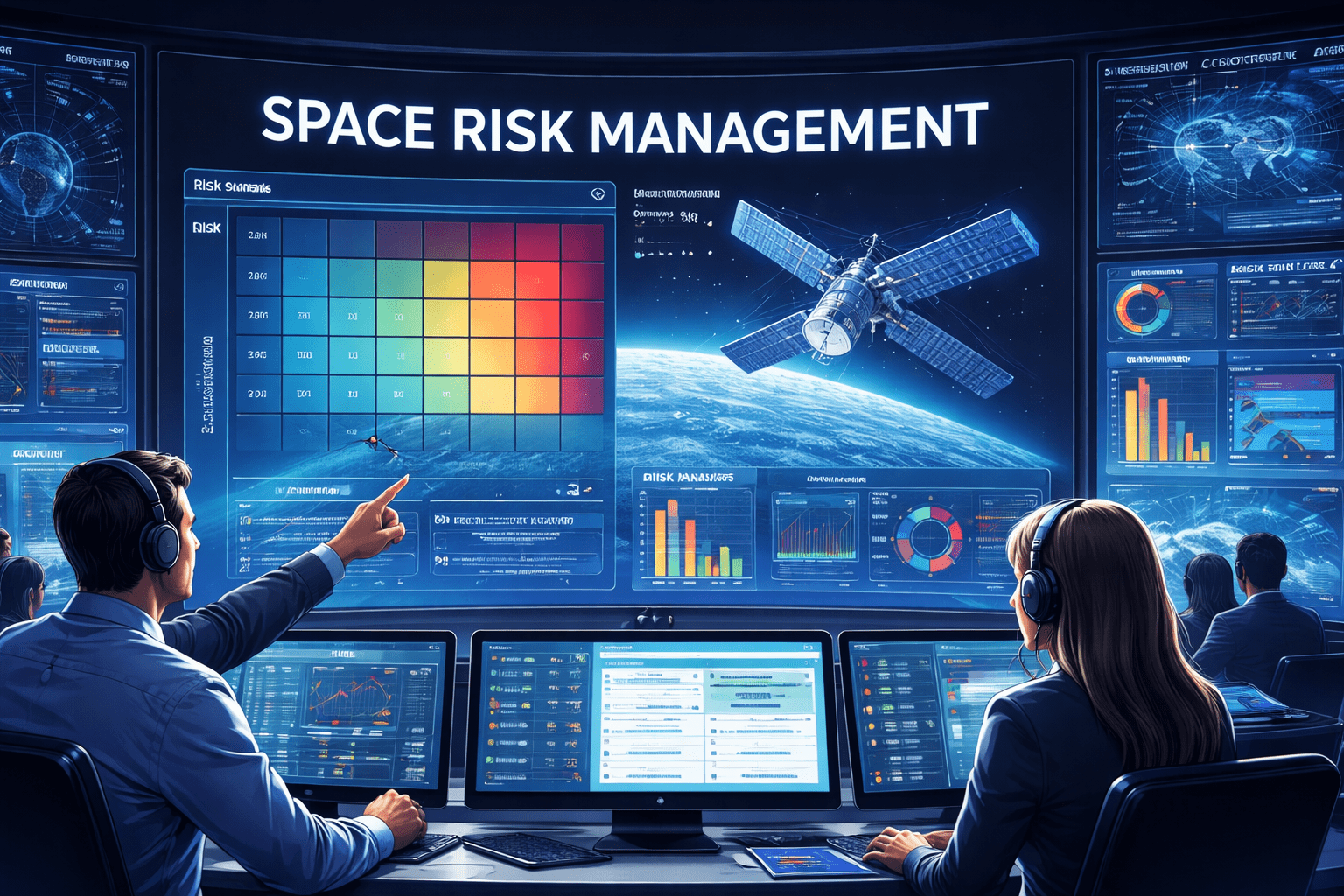
In practical terms, risks are often assessed using structured methods such as likelihood-versus-severity matrices, risk scales, and diagrams. These tools help teams evaluate the probability of a given scenario and the seriousness of its consequences. The consequences may be technical, financial, operational, or schedule-related. Once ranked, risks can be prioritized so that the most critical ones receive the strongest attention.
This process is valuable because it transforms vague concerns into visible decision items. Instead of saying that a subsystem may be problematic, teams can characterize the risk in terms of expected impact and likelihood, assign ownership, and define response actions. This creates transparency and makes it easier to review the status of mitigation over time.
Space programs often revisit their risk lists regularly, with cost and schedule risks frequently remaining among the most restrictive categories. However, technical hazards such as structural safety issues, debris impact, reliability margins, materials performance, or qualification gaps can also remain high on the agenda depending on mission type.
Key insight: Strong space risk management is not about eliminating uncertainty. It is about making uncertainty visible, assignable, measurable, and manageable before it damages mission objectives.
Space Risk Management in Mission Phases
Risks appear across the entire mission lifecycle. During design, the project may face requirements instability, immature technologies, supplier uncertainty, or interface incompatibilities. During build and integration, manufacturing defects, schedule slippage, logistics delays, or test anomalies may emerge. Transportation and launch introduce additional exposure, including handling issues, launch vehicle dependencies, environmental stresses, and countdown-related problems. Operations bring their own risks, such as communication anomalies, power issues, software faults, space weather, or orbital hazards.
A failure before launch can already generate major consequences, including added cost, lost time, and reduction of mission capability. A failure during or after launch can have even more severe effects, including total mission loss. That is why space risk management must be continuous rather than phase-limited. The project cannot assume that once a review is passed, the risk challenge is over. Each stage introduces new uncertainties and changes the context of existing ones.
For this reason, regular reassessment is standard practice. Risks must be updated, re-ranked, and discussed as the mission evolves. Mitigation actions may need to be strengthened, modified, transferred, or escalated depending on project status.
The Role of Standards in Space Risk Management
Standards play an important role because they create structure around management practices. In the European framework, the prime management standard of the European Cooperation for Space Standardization places risk management in a central position among management activities. This reflects the reality that uncertainty affects planning, procurement, engineering, reviews, product assurance, and mission execution all at once.
Standards help ensure that risk is not handled informally or only when problems become urgent. They encourage a systematic process in which teams identify new threats, assess their significance, define mitigation actions, and maintain a transparent path for review and approval. This systematic approach is one of the strongest defenses against complacency in complex programs.
Similarly, large programs in other institutional environments also rely on structured risk management processes to maintain control over technical, schedule, and cost exposure. In major international programs, responsibilities may be divided between agencies, prime contractors, and partners, but the need for a clear and repeatable framework remains the same.
Best Practices for Managing Space Risks
Several best practices consistently strengthen space risk management. First, risk identification should start early and continue throughout the mission rather than being limited to formal review points. Second, risks should be documented clearly, with ownership, status, and response actions visible to the right decision-makers. Third, cost and schedule contingencies should be treated as essential planning tools rather than optional margins.
Fourth, managers should distinguish between avoiding a risk, reducing it, transferring it, or accepting it. Some threats can be avoided by not entering high-risk business areas or by changing technical choices early. Others can be reduced through better controls, more testing, or stronger supplier oversight. Some may be transferred to specialized external experts. And some must simply be accepted, provided the project understands the implications.
Finally, project teams should remain open to opportunity management as well. Staying updated with technological advances, market changes, and industry best practices can create positive outcomes that improve the mission. Risk management is therefore not just defensive. Done properly, it is also strategic and enabling.
Build a Stronger Understanding of Space Projects and Markets
Risk management, cost control, governance, and mission planning are all part of how the space economy functions in practice.
The SEAC Space Economy Course helps professionals connect technical projects with market logic, policy, institutions, and long-term industry strategy.
Conclusion
Space risk management is indispensable to successful space missions because it allows teams to identify, assess, prioritize, and respond to uncertainty across the entire project lifecycle. By analyzing inherent, residual, and secondary risks, projects can allocate resources more effectively, prepare better responses, and improve the likelihood of mission success.
Effective risk management also supports smarter decisions. It helps project leaders understand where cost and schedule pressures are most severe, where technical issues may escalate, and where opportunities may create value. Clear accountability, transparent review paths, and regular reassessment are all essential parts of this process.
As the space sector continues to evolve in complexity, scale, and ambition, robust risk management will remain one of the most important capabilities behind resilient and pioneering missions. In a field where uncertainty is unavoidable, disciplined risk management is what turns uncertainty into controlled progress.
Frequently Asked Questions About Space Risk Management
What is space risk management?
Space risk management is the structured process used to identify, assess, prioritize, monitor, and respond to uncertainties that may affect a space mission. These uncertainties can influence cost, schedule, safety, technical performance, operations, and overall mission success. The process includes both the management of threats and the recognition of opportunities that may positively affect the project.
What makes space risk management particularly important is the fact that space projects involve high costs, technical complexity, and very limited tolerance for failure. Because many mission phases cannot be repeated easily, risk management must begin early and continue throughout the entire lifecycle.
Why is risk management so important in space missions?
Risk management is important in space missions because small uncertainties can have very large consequences. A technical issue during design can create cost growth and delay. A problem during integration or launch can threaten the entire mission. A failure in orbit may be impossible to repair. This makes early identification and continuous reassessment essential.
Strong risk management helps managers prioritize actions, allocate reserves, assign responsibilities, and prevent isolated problems from becoming systemic failures. It also improves resilience, making projects better prepared to absorb uncertainty without losing control of their objectives.
What is the difference between threats and opportunities in risk management?
In risk management, threats are uncertain events that can negatively affect project objectives, while opportunities are uncertain events that can improve them. Threats may lead to delays, technical failures, quality issues, or added costs. Opportunities may create performance improvements, cost savings, faster delivery, or competitive advantages.
This distinction is important because effective project management is not only about defending against failure. It is also about recognizing when uncertainty can be turned into an advantage. In the space sector, this may include adopting a technological improvement at the right time or using new knowledge to strengthen mission outcomes.
What are inherent, residual, and secondary risks?
Inherent risks are the original risks that exist before any mitigation action is taken. Residual risks are the risks that remain after controls or mitigation measures have been applied. Secondary risks are new risks created by the mitigation response itself.
This classification is useful because it shows that risk management is not a one-step activity. Reducing one risk does not always remove exposure completely, and in some cases it introduces new challenges. Space projects therefore need to monitor not only the original problem, but also the effects of the chosen response.
Why are cost and schedule risks so important in space projects?
Cost and schedule risks are important because they directly affect the feasibility and continuity of a mission. Space projects depend on specialized hardware, highly skilled teams, tight integration timelines, and critical launch windows. If something slips in one area, the consequences often spread across the rest of the project.
For example, a technology issue may require more time to solve, but that extra time can generate higher labor costs, extended testing needs, or delayed launch preparation. This is why cost and schedule risks are often among the most restrictive and closely monitored categories in mission management.
What is a risk owner in a space project?
A risk owner is the person or function responsible for ensuring that a specific risk is visible, tracked, and managed appropriately. The risk owner is not always the same person who carries out the response action. In some cases, the execution is handled by an actionee or specialist team, while the owner remains accountable for oversight and escalation.
This distinction is important because risk response can fail when responsibility is unclear. In complex space projects involving many organizations, assigning ownership clearly helps maintain accountability, faster decisions, and stronger control over mitigation measures.
How are risks assessed in space missions?
Risks in space missions are often assessed using structured methods such as probability-versus-severity matrices, ranking scales, and risk diagrams. These tools allow project teams to evaluate how likely a risk is and how severe its consequences could be. Consequences may affect technical performance, cost, schedule, safety, or operations.
Once risks are assessed, they can be prioritized so that critical items receive the most attention. This structured approach helps management focus resources where they matter most and creates a transparent basis for reviewing whether mitigation actions are working.
Can risk management improve mission success in the space industry?
Yes, strong risk management can significantly improve mission success because it helps teams anticipate uncertainty instead of only reacting to problems. By identifying critical threats early, allocating proper contingencies, clarifying ownership, and reviewing mitigation status regularly, projects become more resilient and more disciplined.
Risk management also supports better strategic decisions. It allows teams to balance innovation with realism, protect budgets and timelines, and recognize when an opportunity may create positive mission value. In a field as demanding as space, that combination of discipline and adaptability is a major success factor.