
AI in Space Exploration (Professional Certificate)
- Space
- 1371 (Registered)

 Download the Brochure
 Download the Brochure
AI in Space Exploration
AI in Space Exploration stands as a pivotal force, demonstrating an impressive annual growth rate of 50%. By 2022, the space industry had generated over $366 billion, with AI-driven advancements contributing significantly to this figure. Careers spanned from AI algorithm developers for autonomous spacecraft navigation (with an average salary of $120,000 annually) to data analysts interpreting satellite-generated data for climate studies and resource exploration.
AI serves as an intellectual cornerstone, optimizing satellite functionality, and facilitating complex operations in extraterrestrial environments. Industry giants like SpaceX rely on AI for satellite constellation management, while NASA’s Mars rovers leverage AI-driven capabilities for terrain analysis. This surge in AI not only fosters scientific curiosity but also generates a surge in job opportunities within space-related sectors. Our AI in Space Masterclass delves into this burgeoning field, elucidating how AI enhances satellite missions.
Over 80% of space-related data was processed using AI algorithms. For example, NASA’s Earth Observing System Data and Information System (EOSDIS) utilized AI to analyze satellite data, aiding in climate studies and disaster management. Over 50% of space industry employers sought professionals skilled in both AI and space technology. For instance, SpaceX employed nearly 100 AI experts by 2022.
Online Course AI in Space Exploration
The short course in AI in Space Exploration offers a clear understanding of AI applications across the space industry. Throughout the Masterclass, learners will focus on AI-driven satellite systems, including their development and operation. Additionally, they will explore other AI applications like space robotics and autonomous spacecraft. Students will gain insights into the integration of AI with space technology, ensuring precise mission planning and data analysis.
AI Fundamentals: Firstly, students will grasp the fundamental principles of AI in space, including understanding how AI algorithms function in space applications, how they process data from satellites, and how they enhance autonomous decision-making in space missions.
AI in real Space Applications : Secondly, a thorough exploration of the entire Product Lifecycle (PLC), covering current possibilities, future developments, potential challenges across different phases of AI development, and an analysis of strengths and weaknesses, will be provided.
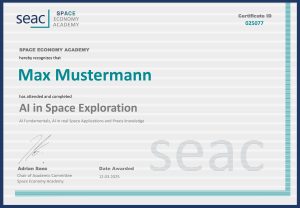
SEAC – Certificate of Completion
Advance your career in AI in Space Exploration with SEAC—first-prize winner of the Galileo Masters University Challenge. Incubated at ESA BIC Hessen with leading industry partners, you’ll earn a Certificate of Completion in AI in Space Exploration.
The skills you will develop
Through this AI in Space Exploration certificate, you will accelerate career, use 360° perspective, develop strategy-managerial skills, recognize AI impacts.
- Accelerate your career in the Space sector with our certificate in AI in Space Exploration.
- Learn about AI in space using a 360 degrees perspective, combining multiple aspects.
- Develop strategy and managerial skills to lead the field.
- Recognize the impact of multiple phases of AI with our Program.
- Learn and develop new innovative strategies based on real-world business experience.
Download the Brochure
Curriculum
- 3 Sections
- 15 Lessons
- Lifetime
- 1. AI Fundamentals5
- 2. AI in real Space Applications8
- 3. Practical Knowledge2
Lecturer

Related Courses