Space Technology for Entrepreneurs (Professional Certificate)
- Space
- 108 (Registered)



The Rise of Space Technology
Space technology is entering one of the most dynamic periods in its history. According to McKinsey, the space technology market is expected to surpass $1.8 trillion by 2040, driven by breakthroughs in launch systems, satellite constellations, in-orbit services, artificial intelligence, robotics, and advanced manufacturing. Over 2,000 active space-tech startups are reshaping the industry, supported by more than $8 billion in annual venture funding dedicated to deep-tech and space-related innovation.
While large aerospace companies continue to lead major missions, the fastest acceleration now comes from agile startups and entrepreneurs building dual-use technologies, autonomous systems, Earth-observation applications, and new commercial space infrastructures. The Space Tech Entrepreneurship wave is driven by rapid innovation cycles, lower launch costs, and scalable digital tools—creating unprecedented opportunities for engineers, innovators, investors, and founders.
About the Space Technology Course
The online course Space Technology provides a complete immersion into the technologies, methods, and innovation models shaping the future of the space sector. The program explores the core technological foundations enabling New Space ventures, as well as the strategic, engineering, and business tools required to build and scale technology-driven startups.
Through a combination of real-world case studies, technical frameworks, and applied project work, participants will understand the entire lifecycle of space technologies—from conceptual design and prototyping to commercialization. The course covers upstream and downstream technologies, including launch systems, satellites, sensors, in-orbit services, AI, data analytics, robotics, and space-enabled software applications.
This course provides Engineers and Entrepreneurs with a structured, business-oriented understanding of space technologies and the space economy. Rather than focusing on engineering depth, the course equips participants with the judgement required to:
This course is intended for professionals seeking to develop a structured understanding of the key technologies enabling innovation and entrepreneurship in the space sector. It is particularly relevant for engineers, managers, entrepreneurs, and professionals interested in understanding how space systems, satellite technologies, AI, and robotics are creating new opportunities for products, services, and technology-driven ventures within the global space industry.
The program is also valuable for decision-makers and professionals who wish to explore the technological, commercial, and strategic dimensions of emerging space technologies and identify opportunities for innovation and business development. Through a practical and structured approach, participants develop the knowledge required to understand how space technologies are developed and applied within companies, start-ups, research institutions, and organizations operating in the evolving space economy.
The skills you will develop
Space technologies are creating new opportunities for innovation and entrepreneurship across the global space sector. Through this course, participants gain a structured understanding of the key space technologies, systems, and infrastructures that enable new products, services, and commercial ventures within the space industry.
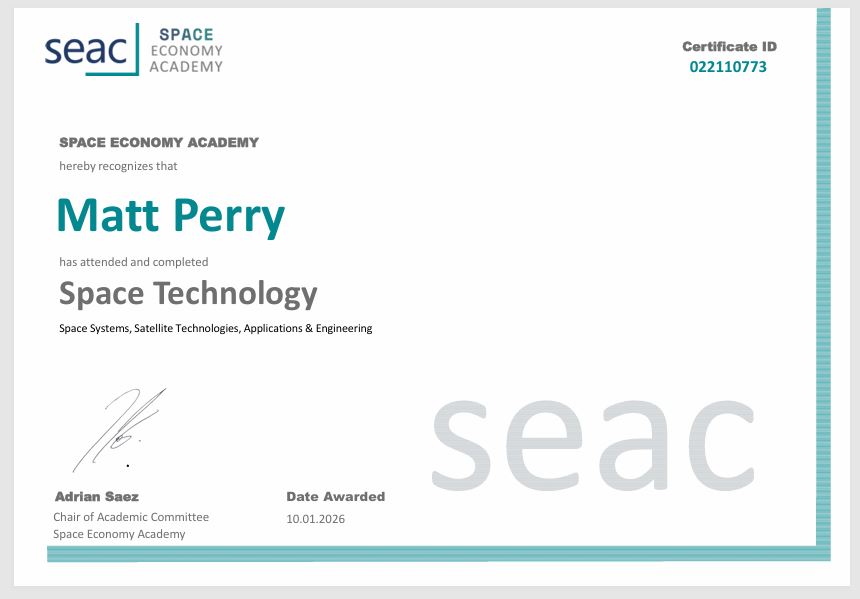
SEAC – Certificate of Completion
Advance your career in Space Economy with SEAC—first-prize winner of the Galileo Masters University Challenge. Incubated at ESA BIC Hessen with leading industry partners, you’ll earn a Certificate of Completion in Space Technology.
Companies & Professional Training
SEAC – Space Economy Academy supports companies, space agencies, and institutions in the professional development of their teams through specialized training in the space sector. Our programs combine industry insight with practical knowledge of the global space economy, helping professionals understand the strategic, technological, and commercial dimensions of the industry. Designed for both technical and managerial profiles, SEAC courses enable organizations to strengthen internal expertise, and develop the capabilities required to operate within the international space sector.
Many organizations choose to enroll several participants in the same program in order to develop shared expertise across their teams and strengthen internal capabilities. Companies enrolling groups of 3 or more participants benefit from exclusive corporate discounts, facilitating the training of multiple team members within the same program. In addition to open-enrolment courses, SEAC can also deliver tailor-made training programs for companies, providing turnkey solutions aligned with specific organizational needs and training objectives.
Space Technology Programme Questions
Key information about the programme format, certificate, tutor feedback, space technology applications, and brochure download.
How is the Space Technology course delivered?
The Space Technology programme is delivered through a flexible online learning format designed for engineers, entrepreneurs, managers, investors, and professionals interested in space technologies and the commercial space sector. Participants can access the educational platform according to their own schedule while progressing through the modules and practical assignments.
Will I receive a professional certificate?
Yes. Participants who successfully complete the programme receive a professional Certificate of Completion issued by SEAC – Space Economy Academy, incubated at ESA BIC Hessen and awarded by the Galileo Masters competition.
Will I interact with lecturers or tutors during the programme?
Yes. Participants complete assignments during the programme and receive individual feedback from tutors and industry professionals. SEAC also organizes selected webinars, alumni events, and industry sessions throughout the year.
Is the programme suitable for working professionals?
Absolutely. The programme was specifically designed for professionals who need flexibility alongside their work responsibilities. Participants can progress through the content at their own pace while maintaining full access to the educational platform and future course updates.
How can the Space Technology course support professionals and companies?
The programme provides a structured understanding of emerging space technologies, including satellites, Earth observation, GNSS, SatCom, AI, robotics, launch systems, in-orbit services, and technology-driven business models. It is particularly valuable for professionals and organizations seeking to evaluate technical feasibility, identify commercial opportunities, and translate space capabilities into scalable products and services.
Where can I download the programme brochure?
The official programme brochure includes detailed information about the curriculum, lecturers, assignments, certificate, learning outcomes, and course structure.
Curriculum
- 6 Sections
- 34 Lessons
- Lifetime
- The Space Technology EcosystemWhere is value really created in the space economy?7
- Satellites Without the PainWhat do satellites actually do—and what are their business constraints?5
- Enabling Space TechnologiesWhich space technologies can I realistically use?6
- Technology Readiness, Risk & Decision-MakingIs this technically viable—and at what risk?5
- From Technology to BusinessHow does technology become a business?5
- From Business Case to Investment ReadinessIs this venture investable?6
Lecturer

Related Courses