
ECSS System Dynamics: How Space Engineering Achieves Stability in Complex Missions
ECSS system dynamics is one of the most useful ways to understand why modern space missions can remain stable despite their extreme technical complexity. Space systems are not isolated components. They are tightly coupled environments where small inconsistencies can rapidly propagate across software, hardware, interfaces, operations, ground systems, and data processing chains.
In the European space ecosystem, this complexity is managed through the European Cooperation for Space Standardization, especially ECSS-E-ST-10C. Engineers usually associate ECSS with lifecycle phases, design reviews, traceability, verification, validation, anomaly management, and documentation. At the same time, many professionals describe it as heavy, rigid, or excessively formal.
That criticism is not entirely wrong, but it misses the real purpose of the framework. The issue is usually not ECSS itself, but how it is interpreted. When ECSS is treated only as a compliance exercise, it feels like overhead. When it is understood as a control mechanism, it becomes essential for engineering stability.
This article explains ECSS system dynamics through a practical lens. Instead of reading ECSS as bureaucracy, we will look at it as a set of balancing feedback loops that help keep complex space projects under control over time.
Key insight: ECSS is not just a documentation framework. It functions like a dynamic control system that detects deviations, triggers corrective action, and reduces the chance of cascading mission failures.
The ECSS Framework in Modern Space Engineering
The European Cooperation for Space Standardization provides a common engineering language for European space activities. This shared framework helps agencies, contractors, suppliers, and multidisciplinary teams work with the same structure, terminology, and technical expectations.
Within this framework, ECSS-E-ST-10C focuses specifically on systems engineering. It defines how a mission should be designed, developed, integrated, verified, validated, and controlled through its full lifecycle. Rather than focusing only on the final spacecraft, payload, or data product, the standard manages the relationships between all project elements.
This matters because space missions depend on interdependence. Instruments depend on onboard software. Software depends on interfaces and requirements. Ground processing depends on upstream data quality. Operations depend on engineering consistency. If one part drifts out of control, the effect can spread rapidly across the full architecture.
Why ECSS Matters Beyond Compliance
Many teams initially see ECSS as a list of requirements to satisfy before passing reviews. That is a limited interpretation. The deeper purpose of ECSS is to reduce uncertainty and maintain control over complexity.
When used correctly, ECSS creates a structured engineering environment where requirements can be traced, design choices can be justified, interfaces can be verified, anomalies can be isolated, and deviations can be corrected before they threaten the mission.
In that sense, ECSS is not an administrative burden. It is a stability architecture for large technical systems.
The V-Model as the Core Logic of ECSS
A central concept in ECSS systems engineering is the V-Model. The left side of the V represents system decomposition. Engineers move from high-level mission goals toward increasingly detailed requirements, architecture, subsystem design, and implementation choices.
The right side of the V represents integration, verification, and validation. Once the system is built, every element is checked against the requirement that originally justified it. This creates a direct relationship between design intent and demonstrated performance.
The V-Model is especially powerful in space projects because it forces consistency across complexity. It helps teams move from abstract mission needs to concrete technical evidence without losing alignment.
Formal Reviews as Engineering Checkpoints
ECSS introduces key milestones such as the System Requirements Review (SRR), Preliminary Design Review (PDR), and Critical Design Review (CDR). These are often described as stage gates, but that description is too static.
In practice, these reviews are active engineering checkpoints. They force teams to expose assumptions, validate maturity, prove technical consistency, and demonstrate that the project can safely progress. If something is not aligned, the process is designed to reveal it early and prevent downstream instability.
Important: ECSS reviews are not just approval ceremonies. They are structured information checkpoints that reveal system health and reduce the chance of late, expensive engineering surprises.
What System Dynamics Means in Space Projects
To understand the deeper logic of ECSS, it helps to look at system dynamics, the field developed by Jay Forrester to explain how complex systems behave over time. System dynamics focuses on interactions, delays, accumulation, and feedback rather than isolated components.
This is highly relevant in space engineering because many project problems do not come from one single broken part. They emerge from interactions across subsystems, decisions, schedules, requirements, interfaces, and late feedback.
Stocks and Flows in Engineering Systems
System dynamics often describes systems in terms of stocks and flows. Stocks are elements that accumulate over time. In a space mission, these include validated requirements, written code, integrated subsystems, open anomalies, verified test cases, and approved interfaces.
Flows are the rates at which those stocks change. Examples include the rate of development, testing speed, requirement change velocity, anomaly closure rate, or integration throughput.
This perspective matters because projects do not usually fail from one isolated event. They fail when rates of change become unstable, information arrives too late, or corrective actions do not keep up with the growth of complexity.
Feedback Loops Define Stability
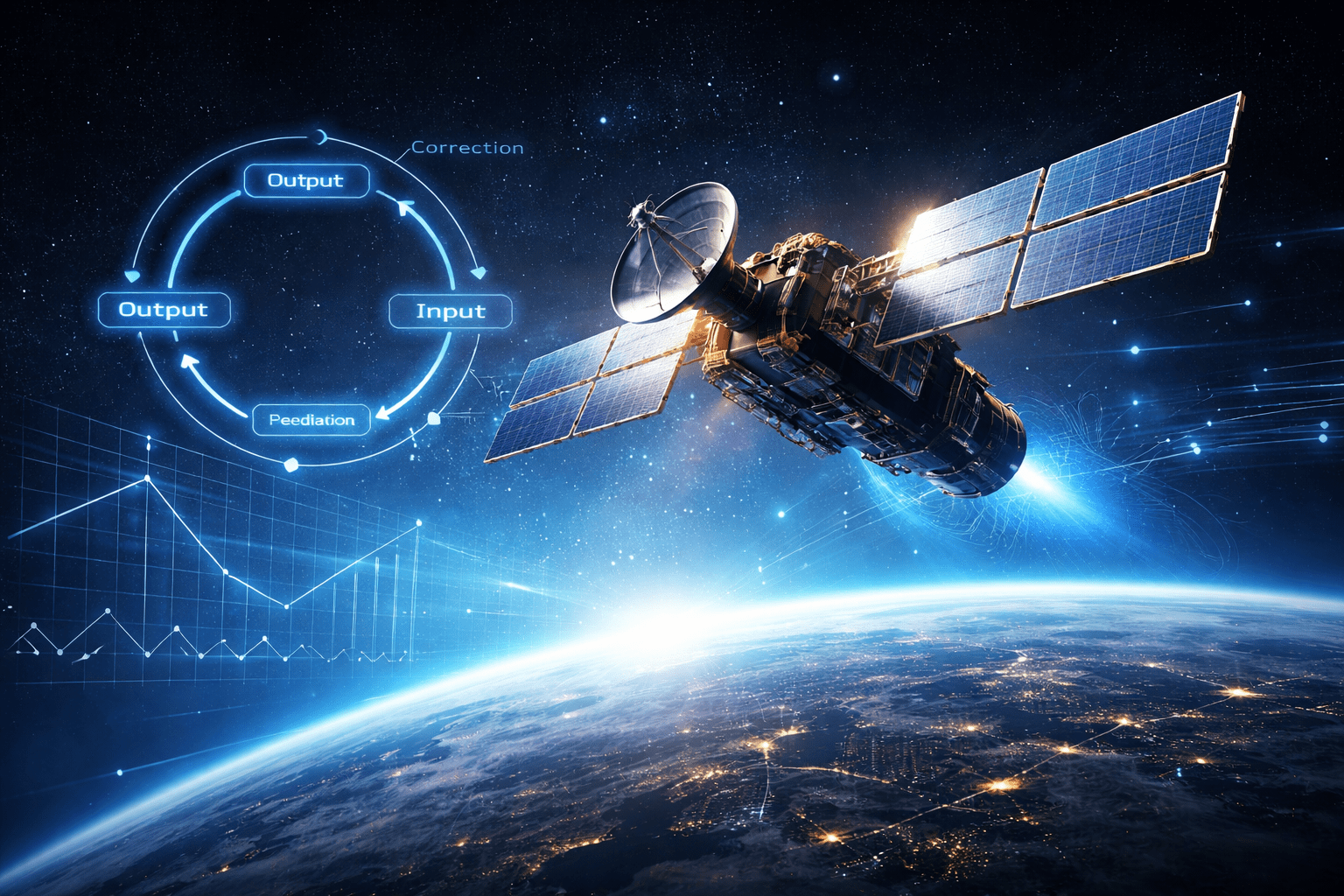
The core concept in system dynamics is the feedback loop. A feedback loop exists when the output of a process influences future inputs of that same process. In engineering terms, what happens now changes how the system behaves next.
There are two main types of loops. Reinforcing loops amplify change. If a problem enters a reinforcing loop, it can grow rapidly. Balancing loops do the opposite. They compare the current state of the system with a desired state and trigger action to reduce the gap.
Space engineering depends on balancing loops because they are what keeps technical complexity under control.
How ECSS Functions as a Set of Balancing Loops
When ECSS is analyzed through system dynamics, it stops looking like a static rulebook and starts looking like a network of balancing feedback loops. Verification, validation, configuration control, anomaly tracking, phase reviews, and traceability all work together to compare actual project behavior with baseline expectations.
Whenever the system drifts away from requirements, ECSS introduces structured corrective action. That action may involve investigation, redesign, re-testing, interface updates, documentation correction, or performance review. The goal is always the same: pull the mission back toward its target condition.
This is exactly how balancing loops function. They detect deviation and reduce it before the system becomes unstable.
Why This Matters in Complex Missions
Large space missions naturally create the conditions for reinforcing loops. A small requirement mismatch can create an interface problem. That interface problem can trigger software workarounds. Those workarounds can introduce new errors. The later the issue is discovered, the more expensive the correction becomes.
Without balancing mechanisms, complexity amplifies itself. ECSS exists to stop that amplification from turning into mission failure.
Real Engineering Example: Satellite Data Processing Stability
This logic becomes especially clear in satellite data processing systems. Consider Level-1b and Level-2 processing pipelines in Earth observation missions. A small calibration error in one spectral algorithm can contaminate a large downstream dataset.
If that error remains hidden, corrupted Level-1b outputs can feed the Level-2 processor and degrade the scientific quality of the final geophysical products. This is a classic reinforcing loop: one upstream issue creates wider downstream consequences.
ECSS counters this through rigorous verification, integration testing, anomaly reporting, and cross-team performance analysis. When a deviation is detected, the process does not simply log it and move on. It forces structured analysis, correction, and re-validation before the project can progress.
That is not bureaucracy. That is engineering stability in action.
Learn ECSS Standards with a 360° Space Project Perspective
If you want to understand how ECSS is applied across project management, systems engineering, product assurance, documentation, and mission lifecycle control, SEAC offers a dedicated ECSS Standards online course.
The ECSS Standards Certificate course is designed as a professional online program covering the key elements of every space project, including management, engineering, product assurance, sustainability, documentation, tailoring, reviews, and lifecycle processes. Public course information also highlights 6 sections, 41 lessons, a certificate of completion, and a listed price of 750 EUR.
Explore the ECSS Standards CourseThe Critical Role of Traceability in ECSS
Balancing loops only work if the information flowing through them is accurate. In system dynamics, poor information leads to poor decisions. In space engineering, that can produce dangerous blind spots.
This is why traceability is so important in ECSS. Requirements, design choices, test evidence, interfaces, software changes, and anomalies must be linked together clearly. Traceability matrices and structured documentation ensure that teams know what changed, why it changed, and what must be re-verified.
Traceability is not valuable because it creates paperwork. It is valuable because it preserves the integrity of the information used to control the mission.
Why Delays in Feedback Loops Are Dangerous
Another core concept in system dynamics is the delay. Feedback rarely arrives immediately. In many projects, there is a time gap between the creation of a problem and the moment when the team becomes aware of it.
This delay is dangerous because late information leads to late action. By the time the issue is detected, the error may already be embedded across interfaces, deliverables, documentation, integration campaigns, or operational assumptions.
Long delays inside balancing loops can create overreaction, oscillation, redesign, schedule slippage, budget growth, and unstable project behavior. In practical terms, the later the issue is found, the harder and more expensive it becomes to fix well.
How ECSS Reduces Delay
ECSS reduces this risk by breaking development into controlled phases and inserting formal reviews, verification activities, and validation checkpoints along the way. Instead of waiting until the end of the project, the framework forces teams to examine system maturity continuously.
For software and data systems, early prototyping and iterative verification reduce the feedback delay from years to months, weeks, or even days. The earlier a deviation is discovered, the smaller, cheaper, and more precise the correction usually is.
Engineering insight: Stability in space systems does not come from getting everything perfect at the start. It comes from building robust feedback loops that detect and correct deviations continuously.
Why ECSS Is Often Misunderstood as Bureaucracy
ECSS is often criticized for being too formal, too documentation-driven, or too rigid. That perception usually appears when the framework is implemented only as a compliance obligation.
If teams focus only on producing documents, attending reviews, and closing actions mechanically, the engineering value of the framework gets lost. The process feels slow because it is being treated as administration instead of as a control system.
When understood properly, ECSS is not the opposite of efficiency. It is what prevents hidden inefficiency later. It reduces the probability that ambiguous requirements, undocumented changes, interface uncertainty, or unresolved anomalies will explode during integration or operations.
Advance Your ECSS Knowledge with Practical Course Content
SEAC presents its ECSS Standards course as a 360-degree program designed for engineers, managers, entrepreneurs, and professionals who need a structured understanding of ECSS organization, requirements management, project lifecycle, systems engineering, and product assurance. Public course material also emphasizes critical thinking, practical application, and relevance for agencies, industry, startups, and academia.
If your goal is to move from theory to real project understanding, this course is directly aligned with the themes covered in this article.
Start the ECSS CourseConclusion
ECSS system dynamics offers a more accurate way to understand how complex missions are controlled. ECSS is not simply a collection of administrative rules. It is a structured method for stabilizing engineering systems that would otherwise drift toward technical and organizational instability.
Through verification, validation, anomaly management, traceability, and formal reviews, ECSS creates the balancing loops needed to keep projects aligned with mission requirements. It detects gaps between expected and actual behavior and turns those gaps into corrective action.
For engineers, project managers, and professionals entering the space sector, this perspective matters. It changes ECSS from something that seems bureaucratic into something clearly operational: a practical system for maintaining control in one of the most demanding engineering environments in the world.
Frequently Asked Questions
What is ECSS in space engineering?
ECSS is the European framework that standardizes engineering, management, and quality processes in space missions, helping teams maintain consistency, traceability, and reliability across complex projects with many technical interfaces.
What does ECSS-E-ST-10C cover?
ECSS-E-ST-10C covers systems engineering activities such as requirements definition, architecture development, verification, validation, lifecycle control, and interface management, ensuring space systems are developed in a structured and traceable way.
Why is ECSS important for satellite missions?
ECSS is important because satellite missions involve tightly connected systems where small errors can spread quickly, so structured controls are needed to detect deviations early and maintain technical and operational stability.
What is system dynamics in space engineering?
System dynamics is a method for analyzing how complex systems change over time, focusing on interactions, delays, stocks, flows, and feedback loops that influence mission stability and engineering decision-making.
How do feedback loops work in ECSS?
Feedback loops in ECSS compare actual system behavior with baseline requirements, identify deviations, and trigger corrective actions, creating balancing mechanisms that keep engineering development aligned with mission objectives.
What are reinforcing loops in space projects?
Reinforcing loops are patterns where small issues amplify over time, such as requirement errors causing interface problems, software workarounds, and downstream failures that become more difficult and expensive to fix.
What are balancing loops in systems engineering?
Balancing loops are control mechanisms that reduce the gap between actual and expected system behavior, helping engineers detect anomalies, apply corrections, and maintain stability throughout the development lifecycle.
Why are feedback delays dangerous in space missions?
Feedback delays are dangerous because hidden problems remain uncorrected longer, allowing errors to spread across subsystems, increase correction costs, and create schedule, budget, and performance instability later in the project.
How does ECSS reduce engineering risk?
ECSS reduces engineering risk through phased reviews, continuous verification, traceability, anomaly tracking, and early validation, making it easier to identify problems quickly and stop them from propagating across the mission.
What is the V-Model in ECSS systems engineering?
The V-Model organizes development by linking requirement decomposition on one side with integration and verification on the other, ensuring each system element is validated against its original design intent.
Why is traceability important in ECSS?
Traceability is important because it links requirements, design decisions, implementation, tests, and anomalies, ensuring accurate information flows through the project and enabling reliable corrective actions when deviations appear.
Is ECSS too rigid for modern space development?
ECSS can feel rigid when treated as paperwork, but its real purpose is to provide control, reduce uncertainty, and support reliable engineering decisions in projects where complexity and mission risk are exceptionally high.