Space Medicine: Protecting Astronaut Health in Space Missions
Author: SEAC – Space Economy Academy
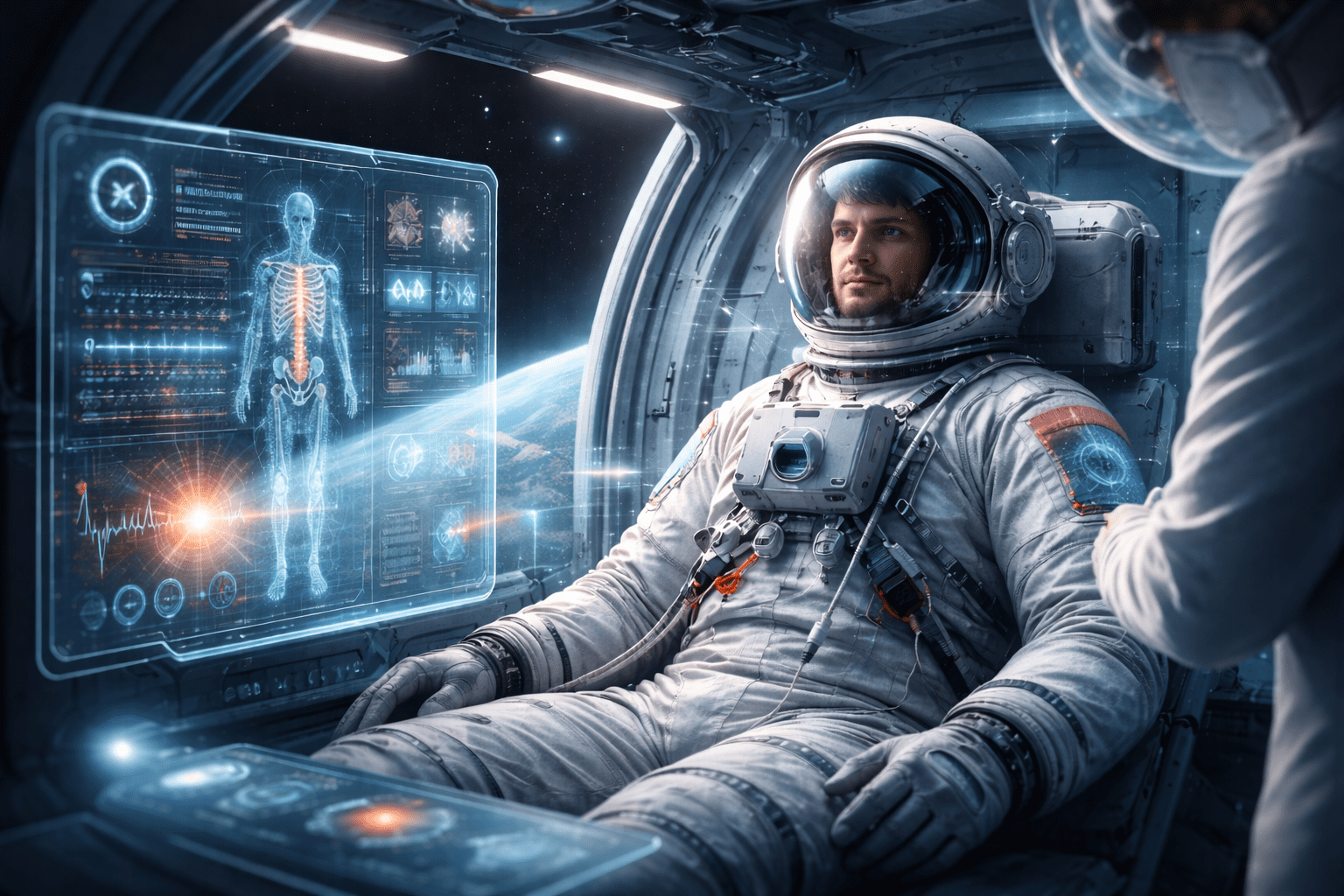
Space medicine is one of the most critical disciplines supporting human spaceflight. As astronauts travel beyond Earth, they are exposed to an environment that challenges nearly every major system in the human body. Microgravity alters muscles, bones, and cardiovascular function. Radiation exposure increases long-term health risks. Isolation and confinement can affect mood, performance, and mental resilience. For this reason, space medicine is essential not only for astronaut safety, but also for the future of long-duration exploration missions.
As human activity in space continues to expand, the importance of space medicine becomes even greater. Missions to low Earth orbit already require careful health monitoring, but future lunar operations, cislunar missions, and deep-space exploration will demand even more advanced medical strategies. The further humans travel from Earth, the more important it becomes to prevent, monitor, and manage health risks in environments where immediate medical evacuation is impossible.
This is why space medicine sits at the intersection of physiology, engineering, psychology, operations, and mission planning. It is not simply about treating illness in space. It is about understanding how the human body responds to extreme environments, designing systems that protect crew well-being, and enabling astronauts to perform effectively throughout a mission and return safely to Earth. In this article, we explore the main challenges of space medicine, from microgravity and radiation to isolation and mental health, and why this field is indispensable for the future of space exploration.
Understand the Space Sector Beyond Technology Alone
Human spaceflight, astronaut health, and mission sustainability are all part of a much broader commercial and strategic ecosystem. For professionals who want to understand how the space sector evolves, it is essential to connect technical topics with markets, institutions, and long-term industry growth.
SEAC’s Space Economy course helps professionals understand the economic, industrial, and strategic forces shaping the future of the space sector, including the expanding role of human spaceflight and mission support capabilities.
Key insight: The success of long-duration human spaceflight depends not only on rockets and spacecraft, but also on the ability of space medicine to protect physical and psychological health in extreme environments.
Why Space Medicine Matters for Human Space Exploration
Space medicine plays a foundational role in enabling human presence beyond Earth. Every space mission places the human body under conditions for which it did not evolve. Gravity, atmosphere, radiation shielding, and environmental predictability are all drastically altered once astronauts leave Earth. This means that even a healthy and highly trained crew member can experience physiological and psychological changes that affect mission safety and operational performance.
The goal of space medicine is not only to respond to medical emergencies. It is also to anticipate risks before they compromise a mission. This includes developing prevention strategies, designing monitoring protocols, testing medical technologies, and supporting astronaut training. It also requires close integration with spacecraft design, habitat planning, life support systems, mission duration analysis, and emergency procedures.
As missions become longer and more ambitious, the medical challenge becomes more complex. A short mission in low Earth orbit and a future mission to Mars do not involve the same level of medical autonomy. In deep-space scenarios, astronauts may face delayed communication, limited resupply, and no immediate return option. In that context, space medicine becomes a mission-enabling discipline rather than a support function alone.
Microgravity and Its Effects on Astronaut Health
One of the most studied topics in space medicine is the effect of microgravity on the human body. Gravity shapes many of our biological systems on Earth, so when astronauts live in an environment with little or no gravitational loading, their bodies adapt in ways that can become problematic over time. These changes affect muscles, bones, the cardiovascular system, fluid distribution, balance, and even aspects of vision and coordination.
Muscle Atrophy and Loss of Strength
In microgravity, muscles do not need to work against body weight in the same way they do on Earth. As a result, astronauts can lose muscle mass and strength, especially in the lower body and postural muscles. For long-duration missions, this is a serious concern because reduced muscle performance can affect mobility, operational capacity, and post-mission recovery once astronauts return to a gravitational environment.
To address this, space medicine relies on structured exercise protocols, resistance devices, and carefully planned physical conditioning. Exercise in space is not optional recreation. It is a medical countermeasure essential to mission health and performance.
Bone Loss and Skeletal Deconditioning
Bone density also declines in microgravity because the skeletal system is no longer under normal mechanical stress. Over time, astronauts can experience bone demineralization, particularly in weight-bearing regions. This increases fracture risk, complicates post-flight rehabilitation, and presents a major challenge for missions lasting months or longer.
Space medicine addresses this problem through exercise, nutritional strategies, biochemical monitoring, and continuous research into how bone remodeling changes in space. The long-term objective is to preserve skeletal health well enough to support both mission tasks and safe re-adaptation after return.
Cardiovascular Changes and Fluid Shifts
Microgravity also causes body fluids to redistribute toward the upper body and head. This contributes to cardiovascular adaptation, facial puffiness, altered circulation, and other physiological changes. Over time, astronauts may experience reduced cardiovascular conditioning, making re-entry and re-adaptation to gravity more demanding.
Because of this, space medicine includes cardiovascular monitoring, exercise regimens, hydration planning, and post-flight recovery protocols. These measures help maintain operational readiness and reduce the health impact of prolonged exposure to weightlessness.
Operational perspective: In space, exercise is a medical intervention. It is one of the most important tools used to reduce the health effects of microgravity during human missions.
Radiation Exposure and Shielding Strategies in Space Medicine
Radiation exposure is another major concern in space medicine. Outside Earth’s atmosphere and magnetic protection, astronauts are exposed to a harsher radiation environment that includes galactic cosmic rays, solar energetic particles, and other forms of ionizing radiation. This exposure can damage cells and tissues, increase long-term cancer risk, and create additional concerns for the nervous system, cardiovascular health, and overall mission safety.
Why Radiation Is a Serious Health Risk in Space
Radiation in space is especially difficult to manage because exposure levels vary with orbit, mission duration, solar activity, and spacecraft shielding. For short missions, the risk profile is more manageable, but for long-duration missions beyond low Earth orbit, the challenge becomes much more significant. Lunar missions, cislunar operations, and future Mars expeditions all raise the importance of medical radiation protection.
This is why space medicine must work closely with engineering and mission design. Radiation is not only a biological issue. It is also a spacecraft architecture issue, a habitat design issue, and a strategic planning issue. Effective protection requires integrated thinking across multiple disciplines.
Monitoring, Shielding, and Countermeasures
Space medicine supports the development of radiation monitoring systems, real-time exposure assessment, operational protocols during solar events, and shielding strategies that reduce risk as much as possible. Medical planning also examines the potential role of pharmaceuticals, biological protection mechanisms, and other advanced countermeasures that could improve resilience during future deep-space travel.
Shielding is particularly important, but it also comes with design constraints related to mass, cost, and mission architecture. For this reason, the field continues to explore a combination of passive shielding, mission timing, habitat planning, and medical monitoring rather than relying on a single solution.
Psychological Challenges of Space Isolation
One of the most underestimated dimensions of space medicine is mental health. Long-duration missions involve isolation, confinement, limited privacy, repetitive environments, and physical separation from family, society, and natural surroundings. Even highly trained astronauts can experience stress, fatigue, interpersonal tension, reduced motivation, or emotional strain under these conditions.
Isolation, Confinement, and Crew Dynamics
The psychological burden of space missions is shaped by more than solitude alone. Crew dynamics, workload, uncertainty, and mission duration all influence mental well-being. In confined environments, small interpersonal issues can intensify over time. Communication delays in future deep-space missions may also reduce the psychological comfort of immediate contact with Earth.
That is why space medicine includes psychological screening, behavioral monitoring, communication support, workload management, and structured approaches to maintaining group cohesion. These measures are designed not only to protect well-being, but also to sustain decision quality, safety, and mission performance.
Support Systems for Mental Well-Being in Space
Mental health support in human spaceflight may include counseling access, guided communication techniques, recreational planning, private time, stress management tools, and carefully designed routines. These interventions are particularly important for long missions, where psychological fatigue can become operationally relevant.
In this sense, space medicine recognizes that astronaut health is inseparable from mission effectiveness. A crew that is physically fit but psychologically strained cannot perform at its best. Protecting mental health is therefore a central part of sustainable human exploration.
The Multidisciplinary Role of Space Medicine
Space medicine is inherently multidisciplinary. It brings together physicians, physiologists, psychologists, biomedical engineers, mission planners, nutrition specialists, exercise experts, and operational teams. No single discipline can solve the medical challenges of human spaceflight alone. Health protection in space depends on integrated systems and coordinated expertise.
This multidisciplinary character is one of the reasons the field is so valuable. Solutions developed for astronaut care often influence wider areas of research, including rehabilitation, remote diagnostics, wearable monitoring, telemedicine, mental health support, and human performance under extreme conditions. In this way, the advances of space medicine can also generate broader benefits beyond space exploration itself.
The Future of Space Medicine in Long-Duration Missions
Looking ahead, the importance of space medicine will only increase. Future missions will involve longer stays in orbit, renewed lunar operations, and eventually deep-space expeditions where autonomy becomes essential. Medical systems will need to become more compact, intelligent, and capable of supporting diagnosis and treatment with limited direct support from Earth.
This means the future of the field will likely include more advanced health monitoring, stronger predictive models, better integration of biomedical data, and improved preventive strategies. Medical planning will need to anticipate not only known risks, but also the possibility of unexpected health events during missions far from Earth.
For humanity to live and work safely in space for longer periods, space medicine must continue evolving from a support discipline into a core pillar of exploration architecture. The success of future missions will depend as much on human resilience as on propulsion, robotics, or habitat design.
Learn How Human Spaceflight Fits Into the Wider Space Economy
Topics such as astronaut health, mission sustainability, and long-duration exploration are increasingly connected to the broader development of the space sector. Understanding these topics in context helps professionals see how technical capabilities, public programs, and commercial ecosystems interact.
The SEAC Space Economy course provides a structured understanding of the economic, strategic, and industrial dynamics shaping modern space activity, from infrastructure and applications to the future of human exploration.
Conclusion: Why Space Medicine Is Essential for the Future of Exploration
Space medicine plays a crucial role in safeguarding astronaut health as humans venture farther into space. The combined challenges of microgravity, radiation exposure, and psychological isolation require continuous research, operational discipline, and innovative countermeasures. Without these efforts, long-duration human spaceflight would face far greater medical and mission risks.
By studying how the body responds to weightlessness, space medicine helps protect muscles, bones, and cardiovascular performance through exercise protocols, equipment, and targeted interventions. By addressing radiation risk, it contributes to safer spacecraft design, mission planning, and long-term health protection. By confronting the realities of isolation and confinement, it helps preserve mental resilience, team cohesion, and overall mission performance.
As space exploration advances, the lessons of space medicine will remain indispensable. This field does more than care for astronauts. It expands our understanding of human resilience, supports safer and more sustainable missions, and enables humanity to push farther into the cosmos while protecting those who make that journey possible.
Frequently Asked Questions
What is space medicine?
Space medicine is the field focused on protecting human health during space missions. It studies how space environments affect the body and mind and develops strategies to prevent, monitor, and manage those risks.
How does microgravity affect astronaut health?
Microgravity can lead to muscle atrophy, bone loss, cardiovascular changes, fluid shifts, and reduced physical conditioning. Space medicine uses exercise, monitoring, and other countermeasures to reduce these effects.
Why is radiation a concern in space?
Astronauts in space are exposed to ionizing radiation from cosmic rays and solar events. This can increase long-term health risks and is a major challenge for long-duration missions beyond low Earth orbit.
What psychological challenges do astronauts face during missions?
Astronauts may experience stress, isolation, confinement, fatigue, reduced privacy, and interpersonal tension. Space medicine addresses these issues through screening, support systems, communication strategies, and behavioral monitoring.
Why is space medicine important for future missions to the Moon or Mars?
Future deep-space missions will involve longer travel times, greater radiation exposure, delayed communication, and limited medical evacuation options. Space medicine is essential for making these missions safer and more sustainable.
Does space medicine have benefits beyond space exploration?
Yes. Research in space medicine contributes to areas such as telemedicine, rehabilitation, wearable health monitoring, psychology, and human performance in extreme environments.